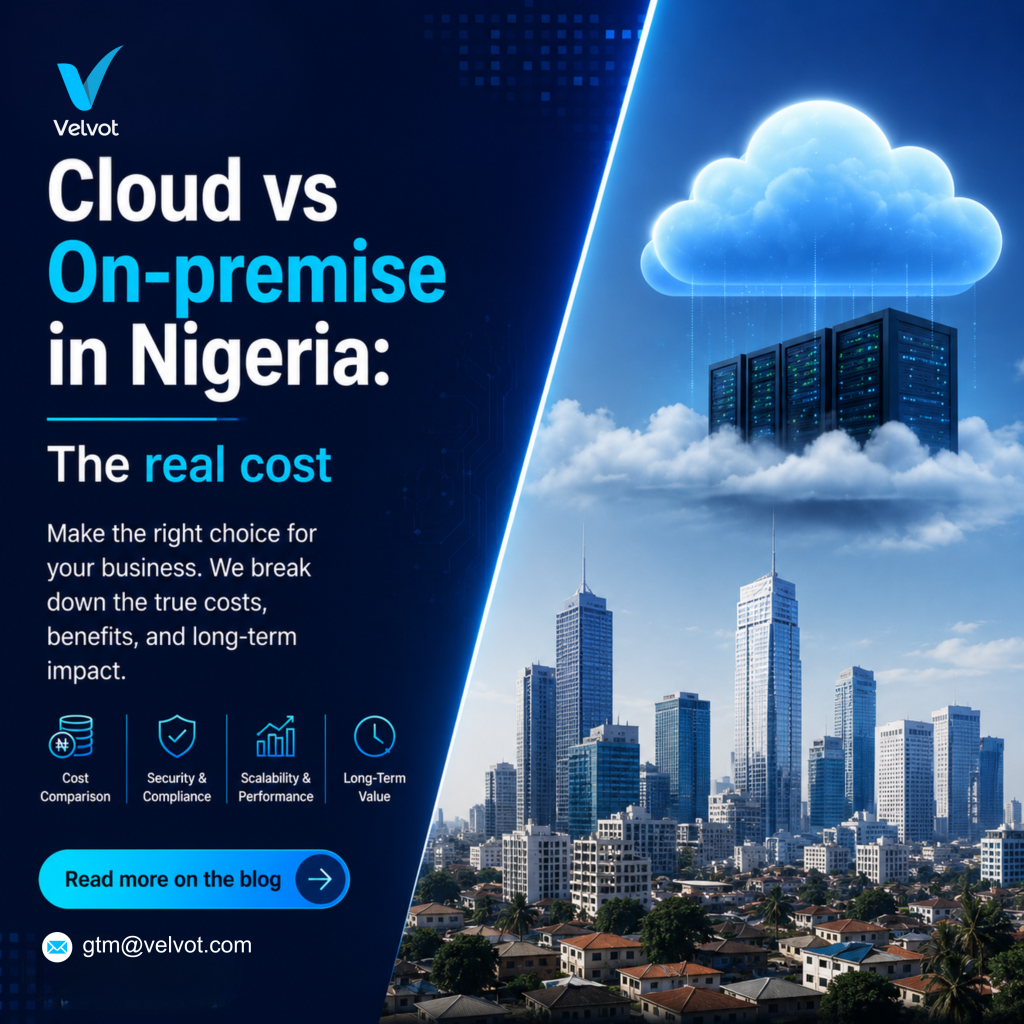
For many Nigerian businesses, choosing between cloud computing and on-premise infrastructure isn’t just a technology decision—it’s a financial one.
At first glance, buying your own servers may seem like a one-time investment that saves money over time. But when you consider the full picture, the costs extend far beyond the purchase price.
Let’s break down what each option really costs.
Understanding On-Premise Infrastructure
An on-premise setup means your servers, storage, networking equipment, and software are hosted within your office or data center. Your organization is responsible for purchasing, maintaining, securing, and managing the entire infrastructure.
Hidden Costs of On-Premise Infrastructure
1. Hardware Investments
Servers, networking equipment, storage devices, UPS systems, and backup solutions require significant upfront capital.
2. Electricity and Power Backup
With Nigeria’s power challenges, businesses often depend on generators, diesel, inverters, or solar systems to keep servers running. These recurring expenses can quickly add up.
3. Maintenance and Upgrades
Hardware eventually becomes outdated. Regular maintenance, replacement parts, warranties, and system upgrades require both time and money.
4. Security
Protecting physical servers from cyber threats involves investing in firewalls, antivirus software, endpoint security, backup solutions, monitoring tools, and skilled IT personnel.
5. Downtime
Unexpected hardware failures or power interruptions can bring business operations to a halt, resulting in lost productivity and revenue.
6. Limited Scalability
Expanding your infrastructure often means purchasing new hardware, increasing storage capacity, and allocating additional office space.
Understanding Cloud Infrastructure
Cloud computing allows businesses to access computing resources such as servers, storage, applications, and databases over the internet. Services are typically billed based on actual usage or predictable subscription plans.
Benefits of Moving to the Cloud
Lower Upfront Costs
Instead of investing heavily in hardware, businesses can spread costs through monthly or annual subscriptions.
Scalability
Increase or reduce computing resources as your business grows without purchasing new hardware.
Improved Business Continuity
Cloud providers offer redundancy, backups, and disaster recovery capabilities that reduce the impact of outages.
Enhanced Security
Leading cloud providers invest billions annually in cybersecurity, compliance, encryption, identity management, and continuous monitoring.
Remote Work Enablement
Employees can securely access business applications and files from virtually anywhere, supporting today’s hybrid work environment.
Automatic Updates
Software patches, security updates, and platform improvements are handled automatically, reducing administrative overhead.
Comparing the Costs
| Factor | On-Premise | Cloud |
|---|---|---|
| Initial Investment | High | Low |
| Monthly Costs | Variable | Predictable |
| Maintenance | Business-managed | Provider-managed |
| Scalability | Slow | Instant |
| Security Investment | High | Shared responsibility |
| Disaster Recovery | Expensive | Built-in options |
| Remote Access | Complex | Native support |
Which Option Is Best for Nigerian Businesses?
There is no one-size-fits-all answer.
Choose On-Premise if:
- You have strict regulatory requirements.
- You require complete control over physical infrastructure.
- Your workloads rarely change.
- You already own modern infrastructure.
Choose Cloud if:
- You want to reduce capital expenditure.
- Your business is growing.
- You support remote or hybrid work.
- You need stronger security and business continuity.
- You want predictable IT spending.
Many organizations are also adopting a hybrid cloud strategy, combining on-premise systems with cloud services to achieve flexibility while maintaining control where necessary.
The Bottom Line
The cheapest option isn’t always the one with the lowest purchase price.
When you factor in electricity, generator fuel, maintenance, hardware replacement, security, downtime, and scalability, cloud computing often delivers a lower total cost of ownership over time—while providing greater flexibility and resilience.
The best approach is to evaluate your organization’s goals, compliance requirements, existing infrastructure, and long-term growth plans before making a decision.
At Velvot, we help organizations assess their IT environment, compare cloud and on-premise options, and build secure, cost-effective infrastructure that supports business growth.
Ready to determine which solution is right for your business? Contact Velvot today for a cloud readiness assessment and expert guidance.
Send an email to gtm@velvot.com.